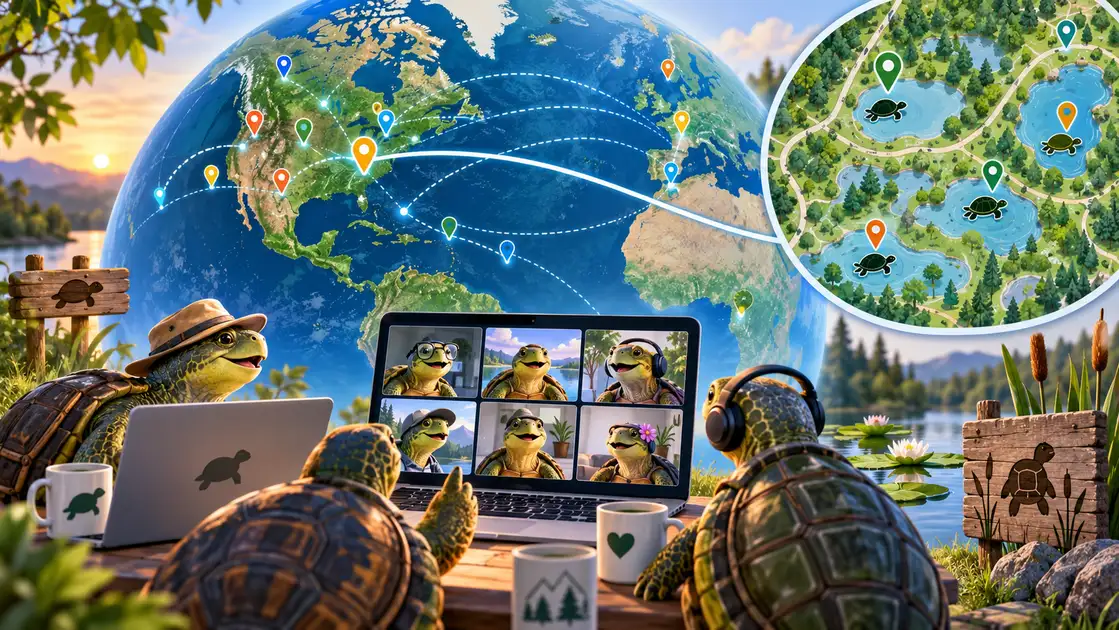

Sometimes the Turtle spirit travels a very long way.
In Basel, Switzerland, Pia and Will Suter have brought together an extraordinary exhibition showing just how deeply turtles have found their way into the art, stories, traditions and conservation efforts of cultures throughout the Americas.
Their exhibition, “Turtles Along the Pan-American Highway,” grew from travels through 18 countries in the Americas, along with several Caribbean islands. Along the way, they discovered turtles almost everywhere — carved from wood, formed in pottery, woven into textiles, incorporated into beadwork, fashioned from natural materials and even used as inspiration for musical instruments.
For those of us in the Turtle Club, it is a wonderful reminder that our fascination with turtles is hardly limited to our own organization.
A Journey Through Turtle Country
Pia and Will’s collection follows a route that stretches across North, Central and South America.
In Canada, they found turtles created from pine needles. In Mexico, turtles appear in colorful beadwork and traditional folk art. Panama offers elaborate textile work, while Peru contributed decorated gourds featuring turtle designs.
Brazil provided both traditional and modern interpretations, and Cuba surprised the Suters with a particularly imaginative variety of turtles.
Throughout the exhibition are wood carvings, pottery, textiles, beadwork and turtles made from materials as varied as coconut, rubber and seeds.
What makes the collection especially interesting is seeing how often the turtle appears in cultures separated by thousands of miles.
The materials and artistic styles may be completely different, but the turtle keeps appearing.
More Than an Animal
The exhibition begins with a version of the Turtle Island creation story presented by Pia and Will.
In the story, land is created upon the back of a great turtle after a woman falls from the world above. Mud brought from beneath the water becomes an island on Turtle’s back, eventually growing into the world.
Stories involving turtles, creation, endurance and the earth appear in a number of Indigenous traditions across North America, and the exhibition uses that connection as a starting point for the journey.
It is an appropriate beginning.
Turtles have been around for an almost unimaginable length of time, and human cultures have repeatedly turned to them as symbols of longevity, patience, strength and the natural world.
That makes them pretty good representatives for us Turtles, too.
Turtles Make Music
One of the more unexpected parts of Pia and Will’s collection is the connection between turtles and music.
During their travels they encountered turtles represented in rattles, flutes and drums, along with stories involving turtles and music.
And, of course, no discussion of turtles and music would be complete without mentioning The Turtles, the American rock group whose “Happy Together” became one of the defining pop songs of the 1960s.
Apparently turtles can find their way into just about everything.
From Collecting to Conservation
The journey also led Pia and Will beyond turtle art and folklore and into the very real challenge of protecting living turtles.
They visited turtle conservation projects during their travels, including programs in the United States, Costa Rica, Brazil and Mexico.
One organization became particularly meaningful to them.
In Tecolutla, Veracruz, Mexico, they developed a relationship with Vida Milenaria, a community organization that has worked for decades to protect sea turtles and their nesting areas.
Pia and Will continue to support that work, including through proceeds from sales associated with their museum collection.
Vida Milenaria’s conservation work continues today, protecting nests, educating visitors and helping new generations understand the importance of sea turtle conservation.
That connection gives this exhibition another dimension. What begins as a collection of fascinating turtle objects eventually leads back to the animals themselves — and the responsibility we share for helping protect them.
An International Turtle Connection
There is something especially enjoyable about receiving a story like this at the Turtle Club.
Our traditions may involve asking whether someone is a Turtle, exchanging passwords and having a little fun together, but the turtle itself connects people on a much larger scale.
Pia and Will’s collection demonstrates that beautifully.
Across 18 countries, different languages, different cultures and countless artistic traditions, they kept finding turtles.
Some were serious.
Some were spiritual.
Some were practical.
Some were whimsical.
And some probably made them stop and say, “We have to take that turtle home.”
We can relate.
The current Basel exhibition continues through October 24, 2026, and Pia and Will are planning a final showing in spring 2027.
From Basel, Switzerland, to Turtle Ponds around the world, we appreciate Pia and Will sharing their journey with us.
It turns out the world is filled with Turtles.
You just have to know where to look.
Inside the exhibition invitation
Images from Pia and Will Suter’s invitation to Turtles Along the Pan-American Highway, shared with permission.


Pia's Invitation:
Turtles Along the Pan-American Highway
An exhibition by Pia and Will Suter in Basel, Switzerland
Pia and Will Suter invite Turtle lovers to visit their exhibition, Turtles Along the Pan-American Highway, featuring turtle art, crafts, folklore, music and conservation stories gathered during their travels throughout the Americas.
A World on the Back of a Turtle
The exhibition begins with the image of the world being formed on the back of a turtle.
In the version of the Turtle Island creation story presented in the exhibition, a woman falls from the world above toward a great sea. Turtle sees her falling and calls upon the water beetle, which dives to the bottom and brings mud back to Turtle's shell.
From that mud, a small island begins to grow. The woman and a sacred tree land upon it, and the island continues to grow until it becomes Turtle Island.
Pia and Will dedicated Turtles Along the Pan-American Highway to this idea of a world carried on the back of the turtle.
18 Countries and Many Turtles
Their journey takes visitors through 18 countries in the Americas, along with several islands in the Caribbean. Pia and Will found turtles especially frequently in the United States and Mexico, but turtle imagery appeared throughout their travels.
The exhibition includes a wide variety of:
- Wood carvings
- Pottery
- Textiles
- Beadwork
- Folk art
- Musical instruments
- Turtle figures made from rubber, coconut, seeds and other natural materials
Turtles Across the Americas
In Canada, the collection includes a turtle made from pine needles.
In the southwestern United States, turtles appear in many Indigenous artistic traditions, including pottery and other ceremonial and cultural objects.
Mexico provided some of the most colorful examples, including intricate beadwork and imaginative folk-art sculptures.
From Panama come examples inspired by traditional layered textile work. In Brazil, turtle imagery appears in both Indigenous traditions and modern artistic interpretations.
Peru contributed beautifully decorated gourds featuring turtles, while Pia and Will were surprised by the number and creativity of turtle figures they discovered in Cuba.
One of the fascinating aspects of the collection is seeing how people in different countries and cultures have created remarkably different interpretations of the same animal.
Turtles and Music
The turtle also appears as a musical instrument.
Pia and Will encountered turtles incorporated into rattles, flutes and drums, along with traditional stories connecting turtles with music.
The exhibition even reaches into modern pop culture with a nod to The Turtles, the 1960s American rock group best known for Happy Together.
Conservation Along the Journey
Their travels also brought Pia and Will into contact with organizations working to protect living turtles.
They visited conservation projects in the United States, Costa Rica, Brazil and Mexico, including turtle protection efforts in Mazunte, Akumal and Tecolutla.
In Tecolutla, Mexico, they developed a special relationship with Vida Milenaria, a community organization dedicated to sea turtle conservation.
Pia and Will continue to support this work, including through proceeds from sales connected with their museum activities.
Visit the Exhibition in Basel
Pia and Will Suter
Basel, Switzerland
Group visits may also be arranged by prior appointment outside the listed public opening hours.
Accessibility note: The exhibition rooms are located on the second floor of the building and are accessible only by stairs.
Remaining October 2026 Public Hours
| Date | Hours |
|---|---|
| Wednesday, October 21 | 4:00–7:00 PM |
| Thursday, October 22 | 11:00 AM–2:00 PM |
| Friday, October 23 | 4:00–8:00 PM |
| Saturday, October 24 | 4:00–8:00 PM |
Final showing: Pia and Will plan one final presentation of the exhibition in spring 2027.
“We hope this brief introduction has sparked your interest and look forward to welcoming you to our exhibition soon.”
— Pia and Will Suter
Pia and Will have invited friends, colleagues and fellow Turtle enthusiasts to share information about the exhibition.